

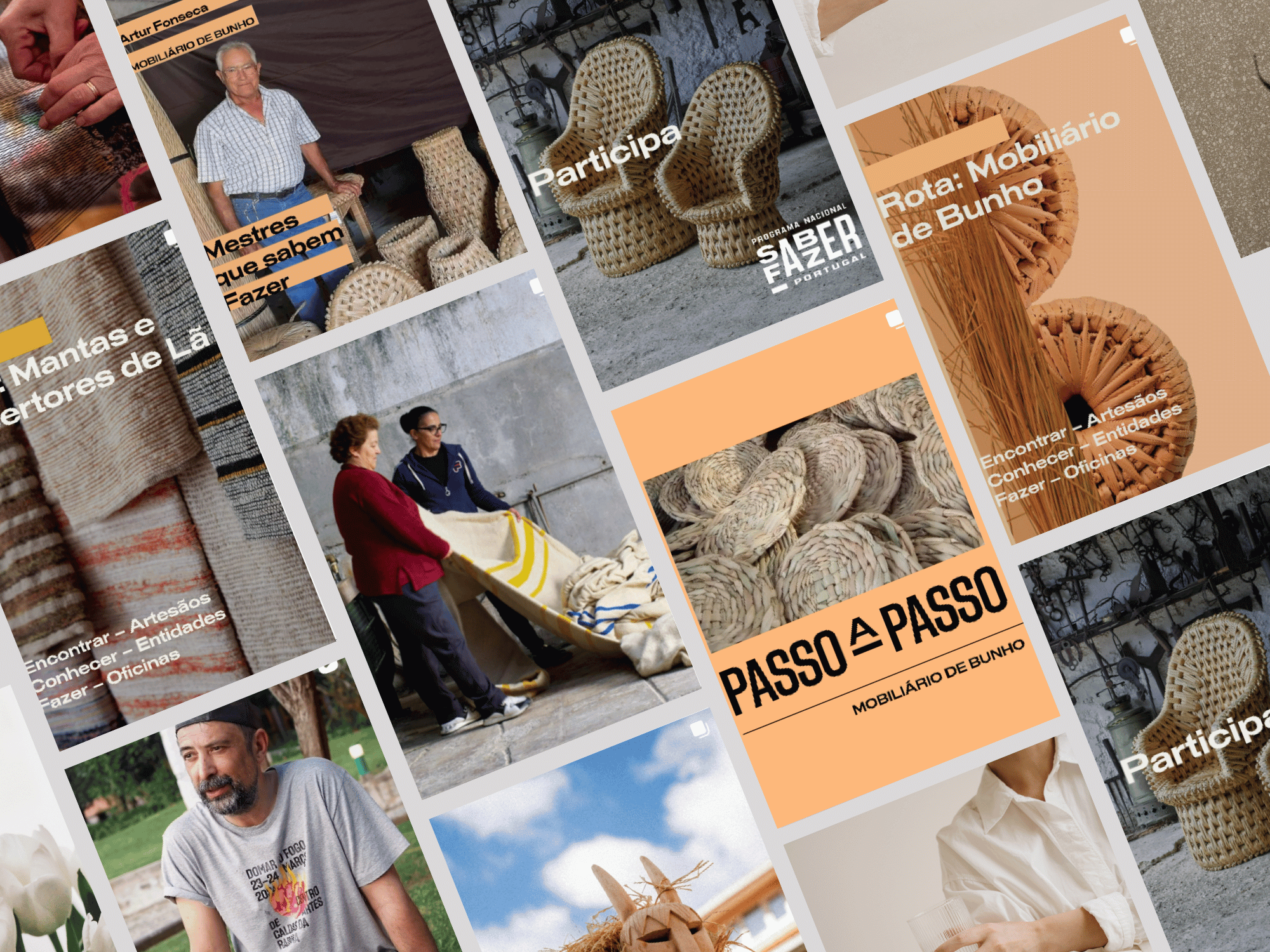
The Saber Fazer Portugal Program is a national initiative dedicated to safeguarding, promoting, and passing on traditional Portuguese arts and crafts. The program recognizes this knowledge as living cultural heritage, essential to collective identity, promoting awareness, documentation, and the continuity of craft practices in dialogue with the present.
In a context where communication takes place mainly in the digital realm, the challenge was to give visibility to a deeply human, manual, and territorial heritage without distorting its character. The goal was to make Saber Fazer understandable, relevant, and accessible to diverse audiences, while maintaining the program's institutional rigor and cultural depth.
The communication strategy was designed based on three clear objectives.
Increase recognition of the Saber Fazer brand, ensuring a consistent and easily identifiable identity.
Deepen emotional engagement with the audience, creating closeness and a sense of belonging.
Expand the reach of communication, taking the program's message beyond existing audiences.
The work began with consolidating the identity of the Saber Fazer Program in the digital space. The brand's personality, guiding principles, and tone of voice were defined, ensuring consistency between message, language, and visual presence.
The consistent application of graphic identity and visual elements on social media allowed us to create continuity and immediate recognition. Communication began to clearly answer essential questions such as what the program is, who it is for, and why it is relevant, ensuring that the first contact with Saber Fazer was informative and memorable.
Engagement was adopted as a central pillar of the strategy. Rather than simply communicating institutional information, the approach focused on creating an emotional connection with the audience, valuing people, stories, territories, and practices.
Communication pillars were defined to guide content production, helping to structure consistent narratives aligned with the program's mission. This organization made it possible to create more relevant content, encourage interaction, and stimulate active community participation, transforming followers into close interlocutors of Saber Fazer.
To expand communication beyond its own platforms, the press office played a central role. The goal was to ensure a consistent and contextualized presence in the media, reinforcing the program's visibility, credibility, and institutional recognition.
The strategy was based on the three fundamental dimensions of institutional, sociocultural, economic, and human know-how, adapting messages and editorial angles to different media, audiences, and moments of communication. Rather than publicizing specific actions, the press work sought to explain the program as a whole, clarifying its mission, impact, and relevance in the Portuguese cultural context.
Strategic communication moments were defined throughout the year, aligned with the program calendar, events, institutional announcements, and initiatives in the territory. This continuity allowed for the construction of a sustained narrative, avoiding a fragmented and episodic media presence.
The coordination between national, regional, and specialized media helped expand the reach of Saber Fazer, reach new audiences, and consolidate its position as a leading initiative in promoting traditional arts and crafts in Portugal.
The work carried out created a solid foundation for communicating the Saber Fazer Program, reinforcing brand recognition, deepening the connection with the audience, and expanding the reach of its mission. The strategy allowed the program to be positioned as a contemporary cultural reference, capable of communicating tradition with clarity, relevance, and a sense of continuity.